 |
| Book Cover Photo by Ngozi Maduoma. |
This week’s reading began with a
really interesting quote from Lucian Marin’s blog, which stated, “Before
Twitter, Flickr was the only social network I needed.” I found this quote quite
interesting; partly because I do not know many people that use Flickr and
mostly because I have never used that platform. It’s intriguing that it was or
is a social network platform that had such a huge impact on its user. Van Dijck
(2013), in her last four chapters discussed about Flickr, YouTube, Wikipedia
and the ecosystem of connective media. She referred to Flickr as one of the
best-known online photo-sharing site that was found to foster a “network of
small communities” Van Dijck, 2013). For a second, I thought to myself how
great it would be to be part of this online network. I mean this is what we are
being taught in every global communications class; the need to network. Then
again knowledge, which I have gained so far from this book, made me hesitate.
Remember, one lesson learnt from
last week’s post was the need for users to be cautious and deliberate in online
environments, knowing that there is always more than meets the eye. Besides, this
book has been able to establish that most of these platforms always start off
with great user-based intentions and then along the line, change focus in
pursuit of what the author calls, “connectivity,” which by the way only comes
at the detriment of “connectedness.” Personally, I would rather have “connectedness”
than “connectivity,” and I’m almost certain that this would be the choice of
most users of these platforms. However, this “ecosystem of connectivity” cannot
operate that way. There are users and there are owners; just like there are
wants and needs.
Flickr
and the struggle to balance Users’ want versus Owners’ need
The example of Flickr, which was
bought over by Yahoo, revealed the struggle owners face while creating balance
in the ecosystem. Flickr users wanted the site to remain as it was – community-based,
same interface and with no form of commercialization. But, Yahoo, who became
the owner, needed the site to yield profit, which the platform could not achieve
if it maintained status quo. Notice that I used the word, ‘wanted’ in
describing the users’ desires versus the word ‘needed’ in the case of Yahoo.
This is because, Flickr users do not really need the platform to survive, but, Flickr
needs money to survive and thrive in this culture of connectivity. Therefore,
in this case one cannot blame Yahoo for trying to make ends meet. On the other
hand, running Flickr on the same rules that apply to Yahoo site was not a good
business decision. There must always be some form of compromise in organizational
management. The users were willing to follow the new rules of having to sign up
on Yahoo to access Flickr and adjust to the new interfaces. Yahoo should have
soft pedaled a bit on its rush towards transforming Flickr into a money-making
venture.
It is an ecosystem, in which
players are interdependent; without users, there will be no owners, and without
technology, there will be neither of the two. Hence, the need and struggle to
maintain balance between what users’ want and that which owners’ need. Flickr
is on the decline today, because someone forgot the public relations rule that
no public of an organization should be ignored. Yahoo (Flickr) sort to satisfy managerial
needs and that of commercial users, at the same time adapt to the new trend in
online environments; but ignored the desires of the everyday users of the site.
As a consumer, I don’t consider Flickr a success, and that’s only because I am
basing my judgments in comparison to other social media platforms. However,
according to Van Dijck (2013), when it has to do with online sociality, “success
and failure are not entirely in the eyes of the beholder.” So, don’t quote me! On
that note, I move to the next platform, YouTube – the video sharing site
created as an “alternative” to watching television (Van Dijck, 2013).
YouTube
– the “alternative”
 |
| A snapshot of the YouTube homepage. Photo by Ngozi Maduoma |
The ideology behind the
establishment of YouTube was like that of a rebellious child, right up to the
point where it turned around and became the “prodigal son.” YouTube created a platform
through which anyone in any part of the world could upload videos online and
view that of others. Cool, right? I thought so too! Unfortunately, this
strategy generated problems for the company; so they returned and made peace
with the parent organization – television. Hence, the observable similarities between
the design of the site and that of some television web pages, such as CNN. Also,
the language used on the YouTube site, has more to do with television than a
social networking site; words like “subscribe,”
instead of the usual, “like,” “share” and
“follow,” and “channels” in place of “pages.”
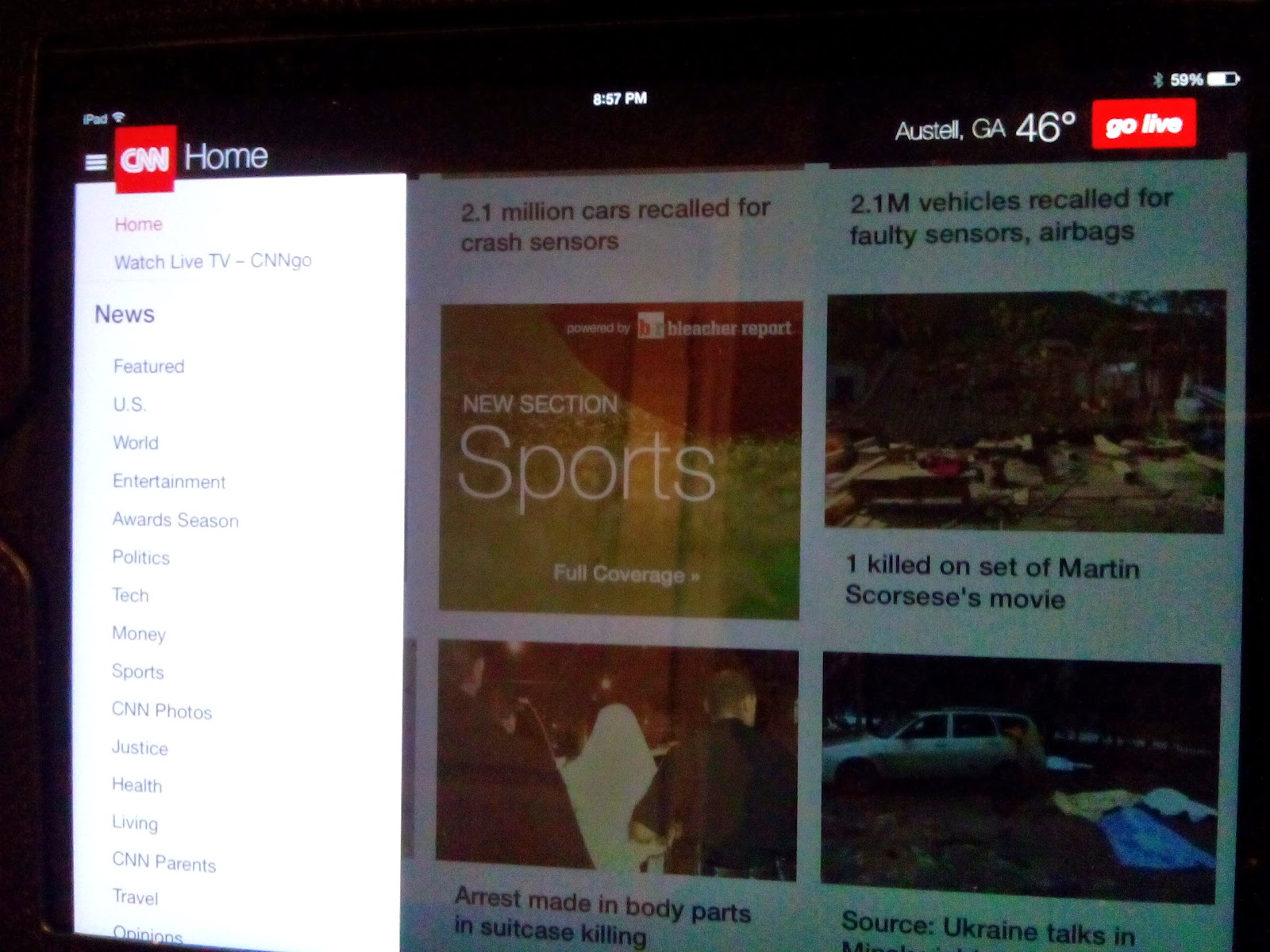 |
| A snapshot of the CNN homepage. Photo by Ngozi Maduoma |
In spite of these changes in the
structure of YouTube, some users still consider it an alternative to television.
One user from Nigeria called Obi, who is also a gospel artist, described it as
a platform that helped him save time that may have been spent watching
television. He also acknowledged that YouTube enables him upload his musical
videos for free and affords him the opportunity to watch only selected videos. Hear
what he has to say! https://www.youtube.com/watch?v=PyvpDfswj9A
This platform adopted another
format and yet it still continued to grow in size. Did you know that “within 8
years, YouTube became the third most popular internet site in the world,
boasting four billion videos and uploading more content per month than all
three major US television networks combined have done in sixty years” (Van
Dijck, 2013). The company was able to accomplish this great feat, because it
created something that was user friendly and different from the traditional way
of broadcasting. It was like a grand theory – a break from the past ideologies
and practices of the media. Users no longer had to pay to air their views, tell
their stories, broadcast their songs and videos to the world. Therefore, even
when it had to adapt to its environment, it still maintained its user volume.
Food
for Thought
Reflecting on this, I wonder if
YouTube thrived only because it had introduced a new trend or because its adaptation
was inclined towards the social environment rather than online environment or “connectivity”
as Van Dijck (2013) calls it. Did individuals and organizations find it easier
to adjust to YouTube’s new interface, because of their familiarity with that kind
of structure (traditional media) and framework? If this is so, just maybe “social
determinism” wins after all. Also, contrary to popular opinion that traditional
forms of media - television, radio and print would be replaced with newer
technologies, they seem to be going nowhere; because according to Van Dijck
(2013), they are now part of the “connective media” and I would like to add, even
setting the pace too, as in the case of YouTube.
Wikipedia
and the “neutrality principle”
Lastly, I cannot but write about Wikipedia, which
asides from being the only non-profit social media platform discussed in this
book, could also be deduced as the author’s favorite. Van Dijck (2013) explained
that, “Amid a sea of goofy videos, pointless babble, tweets, endless updates,
and nippy snapshots, Wikipedia’s encyclopedic content at least has the
dignified status of being verified, impartial, and durable.” I do not contest
the logic of this statement, but last semester, I lost a point in one of my
class assignments for citing Wikipedia as a source. Hence, I’m not sure how credible
this site is considered, if it’s yet to be accepted in academic research.
However, the author of the book, “The
culture of connectivity: A critical history of social media,” made a valid
point as regards the “neutrality principle” applied in the operations of the
site, in comparison to the “popularity principle” that is observed in other
social media platforms (Van Dijck, 2013). Other platforms promote people,
tweets, videos that are considered to be popular online, but Wikipedia only
accepts articles that are written from a neutral point of view – NPoV (Van
Dijck, 2013). For me, this was the only platform I was intrigued by its
business model. I was curious to learn how it was run with no financial profits,
and how it could afford to pay the staff of the Wikipedia foundation.
Eventually, during the course of my reading, I learnt that it had established a
mutually beneficial relationship with Facebook and Google, both of which often
make huge donations to support the site. How neutral, you may want to ask? Your
guess is as good as mine.
The
Conclusion of the book
According to Van Dijck (2013), owners
in the ecosystem of connective media have adopted three ways to ensure that
users stay connected to their platforms. They include the strategies, “Lock in,
fence off and opt out.” Here is a breakdown of how it works. The user is lured
in and “locked in” from liking a page,
to commenting on it and then sharing it, to being recommended to play candy
crush, to downloading it and then, paying to gain access to the next level. Then,
the user is “fenced in” through
ownership and partnership across various platforms (Vertical integration). For
instance, Google has ownership of Google +, YouTube, Gmail, Google search, Google
music store, Google wallet, partnership with Wikipedia and other platforms (Van
Dijck, 2013). So, an individual, who seeks information, clicks on the webpage
of Google search and from there is asked to log in to gain broader access. This
access opens the door to the user being flooded with notifications of other platforms
tied to Google that are available to him or her. The cycle continues as much as
the user keeps on clicking, until it becomes difficult to “opt out.” Sometimes, opting out is harder for some, because of the
technicality involved in the opting out process, and for others, it is the fear
of being isolated from the world of connectivity, which has become the norm in
the society.
So
what?
No one can escape being a part of
this world of connectivity, especially because it has been embraced in most
societies and has become necessary criteria to thrive in this “global village.”
Therefore, I subscribe to this quote from the Bible, “Wisdom is the principle; therefore get wisdom. And in all your getting,
get understanding” (NKJV, Proverbs 4:7). Information is available everywhere
now; so, learn about these platforms and know how best to utilize them to your
advantage.
Till we meet next time, be wise!


